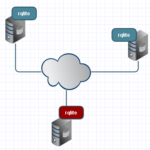
 In September 2014 I published a short post announcing rqlite. The idea was simple: take SQLite, put a Raft log in front of it, and replicate every write to a cluster so that the loss of a node did not mean the loss of the data. The source went on GitHub that same weekend. As far as I can tell, that was the first open-source system to combine Raft and SQLite. Nobody else was doing it, and for several years nobody else tried.
Philip O'Toole
Software engineering, distributed systems, databases, and the teams that build them
Philip O'Toole
Software engineering, distributed systems, databases, and the teams that build them
rqlite 10.5.1 to 10.6.0: Numeric Error Codes, Node Promotion, and CDC Fixes
rqlite is a lightweight, open-source, fault-tolerant relational database built on SQLite and the Raft consensus protocol.
Versions 10.5.1 through 10.6.0 focus on four core themes: richer error reporting in the API, changing a node’s voting status at runtime, a security fix for authentication files, and further work on Change Data Capture (CDC).
Continue reading “rqlite 10.5.1 to 10.6.0: Numeric Error Codes, Node Promotion, and CDC Fixes”
Improved web console in rqlite v10.5.0
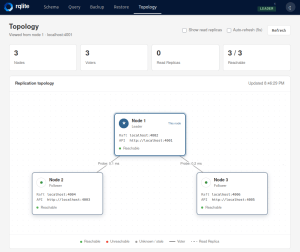 rqlite is a lightweight, open-source, fault-tolerant relational database built on SQLite and the Raft consensus protocol.
v10.5.0 is out now, and comes with an improved web console. Specifically the console features a new cluster topology view, allowing you to quickly understand the state of your cluster.
I continue to use both Claude and Codex for this type of development and both are working very well.
rqlite 10.3.1 to 10.4.0: Cluster Integrity, Streaming Backups, and CDC Security
rqlite is a lightweight, open-source, distributed relational database built on SQLite and the Raft consensus protocol.
Versions 10.3.1 through 10.4.0 focus on four core themes: safeguarding cluster consistency under local fault conditions, overhauling how database backups stream over the network, improving the Change Data Capture (CDC) system, and tightening storage edge cases — partly with the aid of AI-assisted development and testing.
Continue reading “rqlite 10.3.1 to 10.4.0: Cluster Integrity, Streaming Backups, and CDC Security”
Antithesis breaks rqlite on purpose
 rqlite is a lightweight, open-source, distributed relational database built on SQLite and Raft.
Antithesis has published a post on how they use AI Agents to inject bugs in rqlite, then check whether their tests catch them. Along the way their tests found three real bugs in rqlite, which I have since fixed.
rqlite v10.3.0 – features, upgrades, and bug fixes
rqlite is a lightweight, open-source, fault-tolerant relational database built on SQLite and Raft.
Version 10.3.0 has been released and includes some updates to the web console, upgraded SQLite, and other bug fixes and improvements. The headline fix in this release, however, comes courtesy of Antithesis.
Continue reading “rqlite v10.3.0 – features, upgrades, and bug fixes”
From 18 months to 6: High-velocity database engineering
 I recently appeared on the Bug Bash podcast to talk about rqlite, software testing, and the impact of Agentic coding.
You check out the audio podcast on Apple Podcasts, and the video on YouTube.
Claude redesigns rqlite.io
rqlite is a lightweight, open-source, distributed relational database built on SQLite and Raft.
rqlite.io is the Hugo-based website for rqlite, built on the Docsy theme. It introduces people to the database, as well as serving all the technical documentation. Last month I decided to ask Claude Code to redesign the website.
Codex for Open Source
 OpenAI has given me six months of ChatGPT Pro through its Codex for Open Source programme, which backs maintainers of projects the wider ecosystem depends on. I will be putting it to work on rqlite — primarily coding and PR review, as well as the routine maintenance that keeps releases moving.
Many thanks to OpenAI for supporting the work.
Proving to Fable I maintain the repo
rqlite is a lightweight, open-source, distributed relational database built on SQLite and Raft.
After my initial experience with Fable, it got me thinking. I created rqlite, I maintain it. Why won’t Fable help me find and fix bugs in the software? Why does it refuse to identify potential bugs? Because it doesn’t know for sure I am who I say I am.
First impressions of Claude Fable
 Today I tried Anthropic’s latest model, Fable, for the first time. I asked it to run a full code review of the core Go code of rqlite.
Fable rejected my first prompt as unsafe – review the rqlite code base for potential bugs – and Claude Code fell back to Opus 4.8.
rqlite v10.2: Improving the web console
rqlite is a lightweight, open-source, distributed relational database built on SQLite and Raft.
Version 10.2.0 has been released with more improvements to the built-in web console and mutual TLS support.
rqlite reaches 1 million Docker downloads
rqlite is a lightweight, open-source, fault-tolerant database built on SQLite and Raft.
It’s reached a new milestone this week – 1 million Docker downloads. Thanks to the entire rqlite community for their support and engagement with rqlite.
rqlite v10.1: Schema management via the Web Console
rqlite is a lightweight, open-source, distributed relational database built on SQLite and Raft.
Version 10.1.0 has been released with improvements to the built-in web console. The web console now support directly examining the schema of your database tables, and basic schema management.
Humanoid robots won’t surprise us when they arrive
 Today at Lowe’s I passed a Simbe robot doing inventory. A tall pole on a wheeled base, moving the aisles, looking at shelves. I was startled, but only because it appeared behind me. And then I felt nothing. No one else even looked up. The novelty collapsed immediately, because every part of it was already familiar.
Continue reading “Humanoid robots won’t surprise us when they arrive”
Taking control of the SQLite WAL
rqlite is a lightweight, open-source, fault-tolerant relational database built on SQLite and Raft. Version 10 is out now.
rqlite uses SQLite as its storage engine and has a particular relationship with the SQLite Write-Ahead Log (WAL). SQLite, left to itself, manages its own WAL: it checkpoints when the WAL grows, it checkpoints when the last connection closes, and it decides when frames move from the WAL into the main database file.
rqlite 10.0: Better clustering and better management
rqlite is a lightweight, user-friendly, open-source, distributed relational database. It’s written in Go, employs Raft for distributed consensus, and uses SQLite as its storage engine.
rqlite v10.0 has been released and introduces improved cluster and management features, including a new console application served by rqlite itself.
Be sure to download rqlite 10.0 and try it out today. Check out the docs and discussion is welcome on Slack.
Unified Telemetry Management Plane at Google Cloud Next
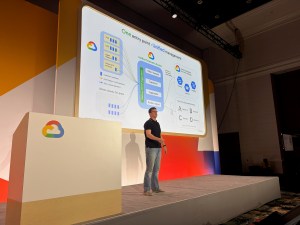 It was great to present with Keith Chen on Google Cloud’s unified telemetry ingestion and routing solution at Google Cloud Next
Our new solution – comprising the Unified Management Plane and Telemetry Router – streamlines telemetry management for Google Cloud customers and developers. The design utilizes OpenTelemetry standards to ensure interoperability and avoid vendor lock-in. You can find the video here.
New guide for working with rqlite clusters
Antithesis chooses rqlite to demonstrate AI-assisted testing
 rqlite is a lightweight, open-source, distributed relational database built on SQLite and Raft.
Antithesis is an autonomous software testing company that runs software inside a deterministic hypervisor, injecting faults and exploring edge cases that the usual testing cannot reach.
Continue reading “Antithesis chooses rqlite to demonstrate AI-assisted testing”
Speaking at GCP Next 2026
 I will be speaking at the GCP Next next month in Las Vegas, NV. My colleague Keith Chen and I will present on GCP’s latest Telemetry management solutions, with OpenTelemetry at the center.
You can learn more about the session here.
Native Linux packages for rqlite
The source code was the moat. But not anymore
 Last week I started using some of the new coding agents properly. Not in a careful, experimental way, but properly — for three days on rqlite. Claude Code. Copilot CLI. Tools I had yet to fully integrate into how I write software.
Continue reading “The source code was the moat. But not anymore”
Discovering git worktrees
 While working with Claude Code, I quickly needed it to operate on multiple versions of the rqlite codebase at the same time. Cloning the repository repeatedly would have worked, but it felt wasteful.
Agentic coding with Claude and Copilot
 After many months of direct ChatGPT use, I’ve finally started coding with the help of Copilot and Claude Code. It’s definitely an intriguing experience. The biggest difference so far? I’m going to hit my Claude Code Pro limits pretty quickly, whereas my Copilot Premium Requests are far from exhausted.